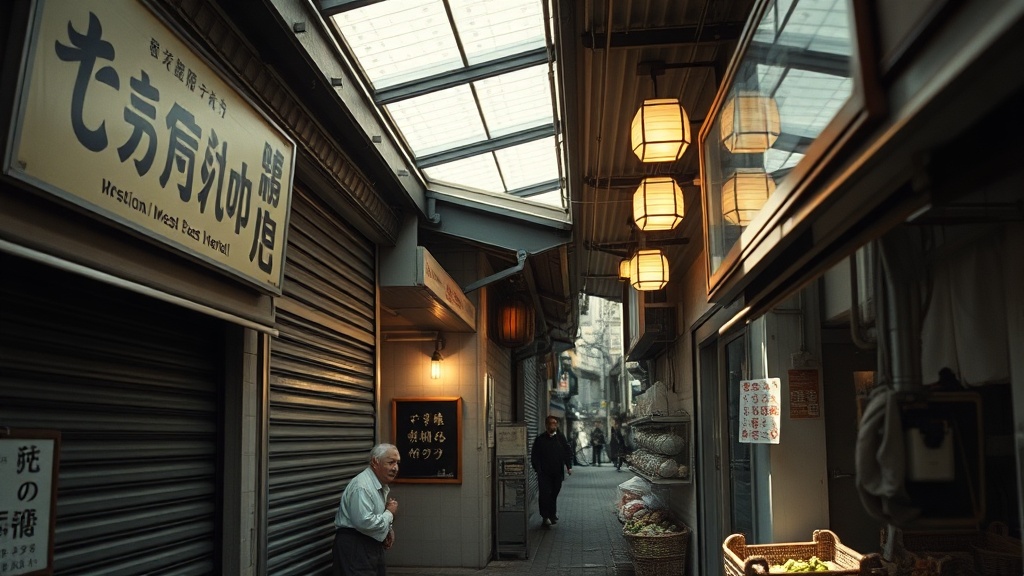
The Last Noodle Maker on the Street: Japan's Shotengai and the Architecture of Daily Encounter

The shutter goes up at the same time every morning
Tsutomu Nishiwaki has been raising the metal shutter of his noodle shop for sixty years. It makes a particular sound — a slow rattle that carries through the narrow corridor of Tateishi Nakamise, a covered shopping arcade in eastern Tokyo. Nobody times their morning by it, exactly. But people notice when it doesn't happen.
I spent three days walking the shotengai of Tokyo and Osaka last autumn, not because they are disappearing — though they are — but because they represent something I keep circling back to in this work: the architecture of daily encounter. The physical spaces that force you to see the same faces, say the same greetings, maintain the small frictions and courtesies that hold a neighborhood together.
A shotengai is, at its most literal, a shopping street. A row of small stores under a shared roof or awning, usually anchored to a train station at one end and a shrine or temple at the other. Japan has roughly 15,000 of them. That number shrinks every year.
What a shotengai actually does
The word translates loosely as "merchant association street," but that misses the point in the same way calling a village pub a "licensed premises" misses the point. A shotengai is where the tofu seller knows your mother had surgery last month. Where the fishmonger sets aside the cuts your husband prefers without being asked. Where the woman who runs the pickle shop watched your children grow up and now watches your grandchildren.
At Shimofuri Ginza, near Komagome Station on the Yamanote Line, shopkeepers remember your preferences after two visits. Not because they are performing hospitality for a travel article. Because remembering is the job. The transaction is secondary to the relationship, and the relationship is secondary to the rhythm.
I watched a retired man spend forty-five minutes moving between three shops on a street that took two minutes to walk end to end. He bought a single daikon radish, a packet of senbei crackers, and a small container of prepared kinpira. At each stop, he talked. Not about anything in particular. About the weather shifting. About a dog he'd seen near the station. About whether the plums would come early this year.
He was not shopping. He was maintaining his social infrastructure.
The Tateishi problem
Tateishi Nakamise began as a black market. After the firebombing of eastern Tokyo in March 1945 — a single night that killed roughly 100,000 people — survivors built makeshift stalls in the rubble. The stalls became shops. The shops became families. The families became a neighborhood.
Now the cranes are visible from one side of the railway station. Apartment blocks and a government office will replace the low-slung arcade. About two-thirds of the shopkeepers have agreed to sell. The rest say they will try to reopen elsewhere, which is a polite way of saying they will close.
Nishiwaki, eighty years old now, told The Guardian's Justin McCurry: "There will be no third-generation owner." His father was one of twenty noodle makers in the area. He is the last. Supermarkets are cheaper. Convenience stores never close. The logic is airtight and completely beside the point.
Koichi Ozaki, whose family runs an izakaya in the arcade, put it more bluntly: "People don't shop in the same way any more. We live in the age of the supermarket, and family-run stores are on their way out."
He is correct. That is precisely the problem.
The geometry of encounter
I keep thinking about something the urban sociologist Jane Jacobs wrote about sidewalks — that their value is not in moving people from place to place but in creating the conditions for unplanned contact. The shotengai does this more deliberately than almost any commercial space I have encountered. The covered roof means rain does not drive people indoors. The narrow width means you cannot avoid eye contact. The mix of food shops, hardware stores, tailors, and tea sellers means you return frequently, for different reasons, encountering different people each time but the same people over months and years.
Modern retail eliminates every one of these features by design. Wide aisles. Self-checkout. Climate control that makes the outside world irrelevant. The supermarket is optimized for the transaction. The shotengai is optimized for the encounter.
Neither is wrong. But they produce different kinds of neighborhoods, and we should be honest about what we are choosing when we let one replace the other.
What the shrine at the end of the street knows
Most shotengai terminate at a shrine or temple. This is not decorative. The shopping street grew outward from the sacred site, merchants clustering along pilgrimage routes the way service stations cluster along highways. The shrine festivals — matsuri — are organized by the same shopkeeper associations that maintain the arcade's shared roof and seasonal decorations.
At Sanjo-kai in Kyoto, the Matatabi-sha Shrine sits inside the shopping arcade itself. The craft beer festival in May and the shrine rituals in July are organized by the same people who sweep the street each morning. Commerce and ceremony share the same infrastructure because they serve the same function: giving people a reason to show up at the same place, repeatedly, and recognize each other.
When the shotengai closes, the festivals lose their organizing body. The shrine remains, but the community that animated it disperses into apartment buildings with intercom systems and package delivery lockers. The sacred site becomes a destination rather than a waypoint. You visit it instead of passing through it. The distinction matters more than it might seem.
Nostalgia is not what I am selling
I want to be careful here. It would be easy to romanticize the shotengai as a lost paradise, and some tourism boards are already doing exactly that — marketing "retro" arcades as Instagram backdrops, encouraging visitors to experience "authentic" Showa-era atmosphere. Janjan Yokocho in Osaka has leaned into this, offering retro game arcades and old-fashioned confectionery alongside the serious commerce that still sustains the street.
But the shotengai was never charming. It was functional. The narrow streets were not designed for photographs; they were designed for a time when most people did not own cars. The hand-painted signs were not aesthetic choices; they were what you did before digital printing. The personal service was not a lifestyle brand; it was the only business model available before inventory management software.
What made the shotengai valuable was not its appearance but its consequences. Daily, embodied, unavoidable human contact. The kind of contact that builds the slow trust between people who did not choose each other but learned, through repetition, to look out for each other anyway.
Kotaro Nagatani, eighty-four, still runs the delicatessen his father opened in Tateishi in 1946, the year after the war ended. His wife, Michiko, told McCurry that their customers come not just to buy prepared dishes but to talk. "You can't do that in a supermarket," she said.
She is right. And that is not nostalgia. That is a diagnosis.
What I carry from the arcade
On my last afternoon at Tateishi, I bought a packet of fresh udon from Nishiwaki's shop. He wrapped it in paper without asking how I wanted it, because there was only one way he wrapped noodles. I carried it back to where I was staying and cooked it badly — too much water, not enough time with the broth.
The noodles were better than anything I could have bought at a convenience store. Not because of the ingredients, which were simple. Because a specific person made them that morning, in a specific place, as part of a specific routine that connected him to sixty years of mornings and a father who taught him the craft and a street that is now counting its remaining seasons.
The world is full of places like Tateishi Nakamise. Places where the infrastructure of human connection is being quietly replaced by the infrastructure of convenience. I do not have a policy recommendation. I am not an urbanist. I am a person who stands in doorways and watches people do ordinary things, and I am telling you that what happens in a shotengai is not ordinary at all. It is the most extraordinary thing a street can do: make strangers into neighbors, one purchase at a time, over decades, without anyone noticing until it stops.