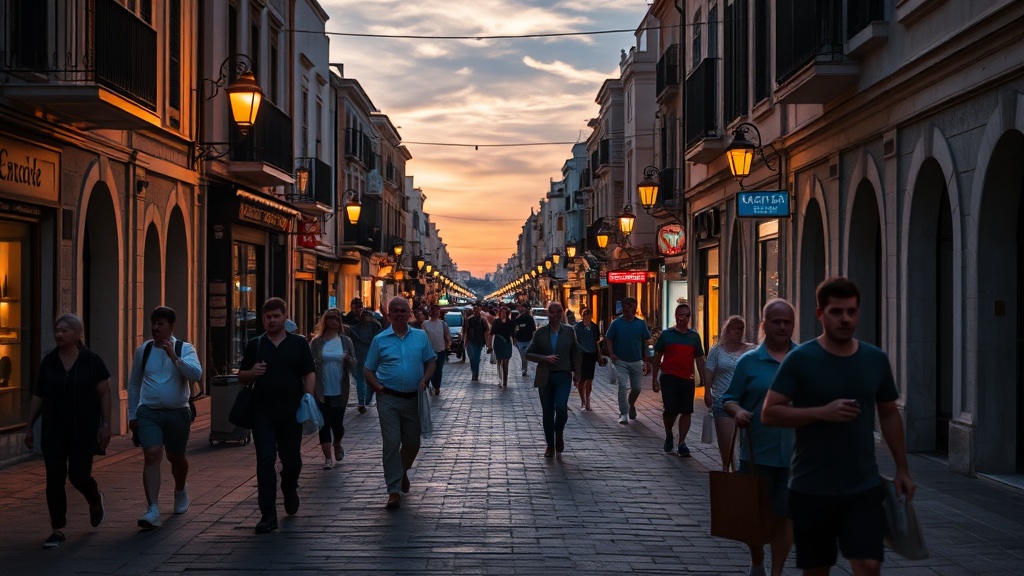
Why Do Mediterranean Streets Fill with Walkers Every Evening? Seven Scenes Worth Observing

Why Do Mediterranean Cities Come Alive After Dark?
Most travel guides treat cities like museums to be consumed—tick off the landmarks, snap the photos, move to the next exhibit. But that's not where life happens. Life unfolds in the pauses between attractions, in the routines that locals repeat thousands of times without thinking. And nowhere is this more visible than in the evening hours across Mediterranean cities, when streets transform from sun-baked thoroughfares into open-air living rooms. The temperature drops, the harsh light softens into gold, and something shifts in the atmosphere. You won't find this in guidebooks because it can't be bought, booked, or Instagrammed. It requires only one thing: your presence. Not your camera (though you'll want it), not your itinerary—just your willingness to stand still, watch, and let the evening unfold around you like a conversation you're not expected to join but are welcome to witness.
What Is the Passeggiata and Why Does It Still Matter?
In Italy, the evening passeggiata isn't exercise—it's a social institution that's survived centuries of modernization. Around six or seven, after the siesta has ended and work has finished, Italians emerge from their apartments dressed impeccably. They don't walk for fitness; they walk to see and be seen, to check the pulse of their community. Grandparents push strollers with a particular pride, teenagers circle in chattering groups, shopkeepers stand in doorways evaluating the passing parade. The loop is usually short—maybe ten blocks—and it happens at a pace that would frustrate any gym-goer. But that's precisely the point. This isn't about getting somewhere. In towns like Lecce in Puglia or Bologna in Emilia-Romagna, the centro storico becomes a parade of connection. You bump into your cousin, your accountant, your old teacher from secondary school. Conversations stop traffic. Hand gestures paint the air. And for the observer, it's pure documentary gold—you're watching a community check in with itself, reaffirming bonds that predate social media by centuries. The passeggiata remains central to Italian identity precisely because it resists efficiency.
How Does Spain's Paseo Create Community?
Cross into Spain and you'll find the paseo—similar in timing but distinctly different in texture. While Italians emphasize presentation and social hierarchy, Spaniards emphasize participation and inclusion. The walk often begins at a plaza and meanders toward tapas bars, but the movement is circular rather than linear, repetitive rather than directed. Families walk together, three generations deep, at an hour when northern European children have long been asleep. In Seville or Granada, the ritual starts late—nine or ten in the evening—and stretches comfortably past midnight. Children who would be in bed in other countries are playing soccer in plazas at eleven, their laughter echoing off cathedral walls. The paseo isn't separate from dinner; it's the opening act, the overture to the main meal. You'll see groups stopping at bars for a caña and a tapa, then moving on, then stopping again, creating a movable feast that covers kilometers without ever leaving the neighborhood. The night unfolds in chapters, each one a little louder, a little more crowded, a little more joyous. By midnight, the streets feel like a festival that nobody planned but everyone attends. This evening rhythm defines Spanish social life in ways that confound visitors who expect dinner at six.
Where Do Greek Islanders Walk During the Evening Volta?
In Greece, they call it the volta—the evening turn. On islands like Naxos, Crete, or Lesvos, the pattern is unmistakable to anyone who watches for more than a day. Around sunset, when the brutal afternoon heat finally breaks, the transformation begins. Shopkeepers sweep their sidewalks with rhythmic precision and set out chairs that will soon be occupied by the same men who sat there yesterday. The promenade—whether it's a harborfront lined with fishing boats or a mountain village's single main street—fills with walkers moving in both directions like blood through arteries. There's a choreography to it that reveals the island's social structure. Older men gather at cafeneions with worry beads clicking in hypnotic patterns, solving the world's problems over tiny cups of coffee. Young couples stroll arm in arm, seeing and being seen. Families parade their babies like precious offerings to be admired by the community. Unlike the directed purpose of the Italian passeggiata, the Greek volta feels more democratic, more chaotic, more delightfully disorganized. You might walk the same hundred meters twenty times, stopping to chat, to gesture dramatically, to argue about politics or football. The night doesn't build toward dinner; dinner happens whenever someone gets hungry, sometimes at ten, sometimes at midnight. Until then, the street is the destination, the event, the reason you showered and dressed and stepped out into the cooling air.
What Makes Turkey's Evening Çay Gardens Special?
In Turkish cities like Istanbul, Izmir, or Antalya, evening social life moves to çay gardens—outdoor tea houses where locals gather not to eat but simply to be together in proximity. These aren't the tourist-filled hookah lounges of guidebooks or the Instagram-curated cafés near major monuments. They're neighborhood institutions with plastic chairs arranged in precise rows, strings of unpretentious light bulbs, and endless glasses of black tea served in distinctive tulip-shaped glasses that burn your fingers if you hold them too long. Families occupy long tables that grow longer as friends arrive. Men play backgammon with the intensity of chess grandmasters, slapping pieces down with theatrical force. The atmosphere is profoundly democratic—a taxi driver sits next to a university professor, both arguing about football with equal passion and authority. The çay garden extends the public square into the night, offering a third space between work and home that modern urban planners try desperately to engineer but can't replicate. And unlike the moving rituals of Italy or Spain, this one is stationary. You claim your table and hold it for hours, watching the street life pass by while conversations deepen, tea glasses multiply, and the evening cools from unbearable to merely pleasant. The garden fills gradually, empties gradually, and maintains a hum of connection that outsiders feel immediately even if they don't understand the language.
Why Do the French Linger Over a Single Drink for Hours?
France approaches evening culture with characteristic deliberation and a stubborn resistance to rushed consumption. The apéro—that pre-dinner drink that's less about the alcohol and more about the pause between day and evening—can stretch across two or three hours without anyone checking their watch. In Lyon, Marseille, or Toulouse, you'll see café terraces filled with people facing the street (never each other, always outward toward the passing scene) nursing a single glass of wine, a pastis, or a kir. They're not waiting for dinner; in many ways, they are having dinner, or at least the social component of it. The French evening is about making time elastic, about refusing the tyranny of schedules. Conversations meander through politics, philosophy, workplace grievances, family updates, gossip about neighbors. Waiters don't rush you—in fact, they'd be confused and slightly offended if you left quickly. This is the liminal time when the workday officially ends and private life begins, and the café terrace serves as the transitional space where these spheres overlap. For the visitor accustomed to American efficiency, it's maddening if you're hungry. But if you're watching with a documentarian's eye, it's fascinating—a masterclass in doing one thing at a time, in being fully present in a moment rather than using it to get to the next thing. The apéro culture remains non-negotiable in French social life.
How Does Morocco Transform at Dusk?
In Moroccan cities like Fez, Tangier, or Chefchaouen, the evening brings a transformation that feels almost magical to the first-time observer. As the call to prayer echoes across rooftops and the light shifts from white to amber, the medina shifts from commercial chaos to social theater. The famous Djemaa el-Fna in Marrakech draws tourists with its snake charmers and food stalls, but smaller squares across the country follow similar, less performative patterns. Food stalls appear as if summoned by invisible signals. Musicians set up circles of chairs. Storytellers gather crowds of children who listen with rapt attention despite having heard these tales before. But beyond the tourist centers, ordinary neighborhoods have their own, more intimate rhythms. Families emerge for walks through streets that are finally cool enough to handle comfortably. Men gather at outdoor cafés with glasses of mint tea that require elaborate pouring rituals. The narrow alleyways, so oppressive in afternoon heat, become corridors of breeze, conversation, and cooking smells. The evening walk here isn't a predetermined loop—it's an exploration, a discovery. You follow your nose toward grilled meat smoke, toward the rhythmic clatter of metal tea trays, toward the sound of drums. The night feels discovered rather than planned, stumbled upon rather than scheduled. And unlike European traditions that value seeing and being seen, the Moroccan evening feels more sensory, more about immersion in sound and smell and the press of bodies in crowded spaces.
How Can You Observe Without Intruding?
There's an ethics to watching that every documentarian learns, and it applies equally to the curious traveler. You're not there to perform poverty tourism or to treat locals like exhibits in your personal museum. The key is reciprocity—buy something from the café where you sit, learn a few phrases in the local language, acknowledge through your posture and behavior that you're a guest in someone's living room. Don't photograph without asking (and honestly, don't photograph at all during your first hour; let your eyes do the recording). Choose a spot and return to it on multiple evenings—familiarity breeds trust, and you'll notice locals nodding to you by the third night. Most importantly, adjust your expectations radically. You won't have a "productive" evening by Western capitalist standards. You might sit for three hours and witness nothing more dramatic than an old man feeding pigeons or a mother scolding her child. But that's exactly the point. These rituals persist precisely because they resist productivity. They value presence over progress, repetition over novelty, connection over consumption. In a world obsessed with optimization and acquisition, the Mediterranean evening offers something genuinely radical: permission to simply be where you are, surrounded by others doing the same, participating in traditions that will outlast your visit and the photos you didn't take.