You Remember Your Neighbors: Morocco's Communal Bread Ovens and the Infrastructure of Daily Life
The first time I watched a ferran baker work, I stood in the doorway for twenty minutes before he acknowledged me. He was sorting loaves by family — each round of khobz marked with a thumbprint or a fork-drag or a small cross of sesame seeds — and he did not need an audience for that. When he finally looked up, he didn't ask why I was there. He asked if I was picking up for someone.
That interaction taught me more about Morocco's communal ovens than any article I'd read beforehand. The ferran is not a curiosity. It is infrastructure.
What the ferran actually is
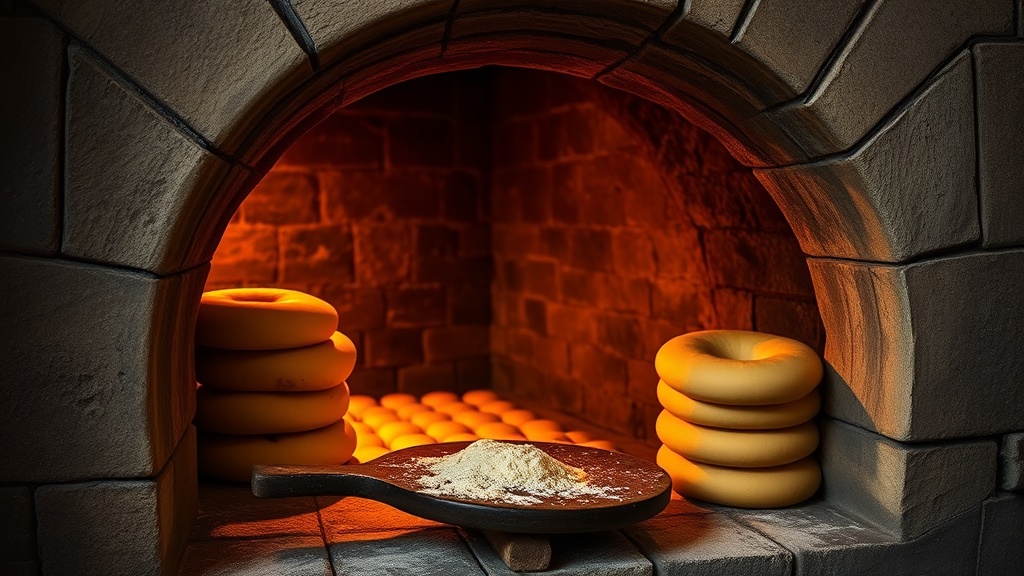
In most Moroccan medinas, families do not bake bread at home. They prepare dough — usually early morning — shape it into thick rounds of khobz, and carry it on wooden boards or aluminum trays to the neighborhood ferran. The baker takes each tray, slides the loaves into a deep brick oven fired by olive wood or sawdust pellets, and keeps mental track of which bread belongs to which household.
The fee is typically one to two dirhams per loaf. Roughly ten cents. For that price, you get expert heat management, fuel you didn't have to buy, and a kitchen that doesn't turn into a sauna in August.
Children often handle the pickup. You see them weaving through narrow alleys balancing trays overhead, unhurried, treating the errand like what it is — not a chore but a rhythm. The bread comes back warm. Lunch follows.
The marking system nobody explains
Every family develops a signature mark on their dough. Some press a knuckle pattern. Others score lines with a knife or dust a specific spice blend on top. One woman in Fez showed me how she always places three sesame seeds in a triangle on each loaf — her mother's mark before her, and her grandmother's before that.
The baker never writes anything down. He reads the oven the way a librarian reads shelves. When I asked one ferran operator in Chefchaouen how he kept two hundred loaves straight in a single morning, he shrugged and said, "You remember your neighbors."
That sentence has stayed with me for years. It is an entire philosophy of community packed into four words.
Why the ferran matters beyond bread
There is a version of this story that frames the communal oven as a quaint relic — something picturesque that tourists photograph on food tours. I have seen that version. It usually includes the phrase "step back in time."
The ferran is not a step back. It is a functioning municipal service that most Western cities abandoned generations ago and are now, ironically, trying to reinvent through community kitchens and shared economy startups.
Consider what the ferran eliminates: redundant fuel consumption across hundreds of households, the cost of individual oven ownership, the isolation of cooking alone. Consider what it creates: a daily reason to walk through your neighborhood, a forced interaction with someone who knows your family by the shape of your bread, a communal space where gossip and grief and weather reports get exchanged without anyone scheduling a meetup.
The ferran is social infrastructure disguised as a bakery.
The pressure on the system
Since the 1980s, the number of ferranes in Moroccan cities has declined. More women entering the workforce means less time for morning dough preparation. Apartment buildings now come with gas ovens. Younger families buy packaged bread from commercial bakeries that operate on industrial schedules rather than neighborhood ones.
In Fez, older ferran operators told me they used to bake for sixty or seventy families a day. Now some handle thirty. A few have closed entirely, their ovens cold, their storefronts converted to phone repair shops or storage.
This is not a simple decline narrative. The women who stopped making daily khobz often did so because they got jobs, pursued education, chose differently. That is not a loss to mourn — it is agency in action. But the infrastructure that connected households to each other is thinning, and nothing obvious is replacing it.
What I think about when I think about the ferran
I think about the fact that a baker can identify a family by a thumbprint in dough. I think about children carrying bread through streets that were built before the concept of sidewalks, doing something useful that also happens to teach them navigation and responsibility and the layout of their own city.
I think about how most urban planning conversations in North America revolve around "third places" — spaces that are neither home nor work where community happens organically. The ferran has been a third place for centuries, and it never needed a TED talk to justify its existence.
I think about the woman in Fez with the three sesame seeds and the fact that her bread mark is a form of inheritance that fits in the palm of a hand.
Mostly, I think about how the smallest daily acts — carrying a tray, waiting for bread, recognizing a neighbor's loaf — are the ones that hold a city together. Not the monuments. Not the festivals. The bread.