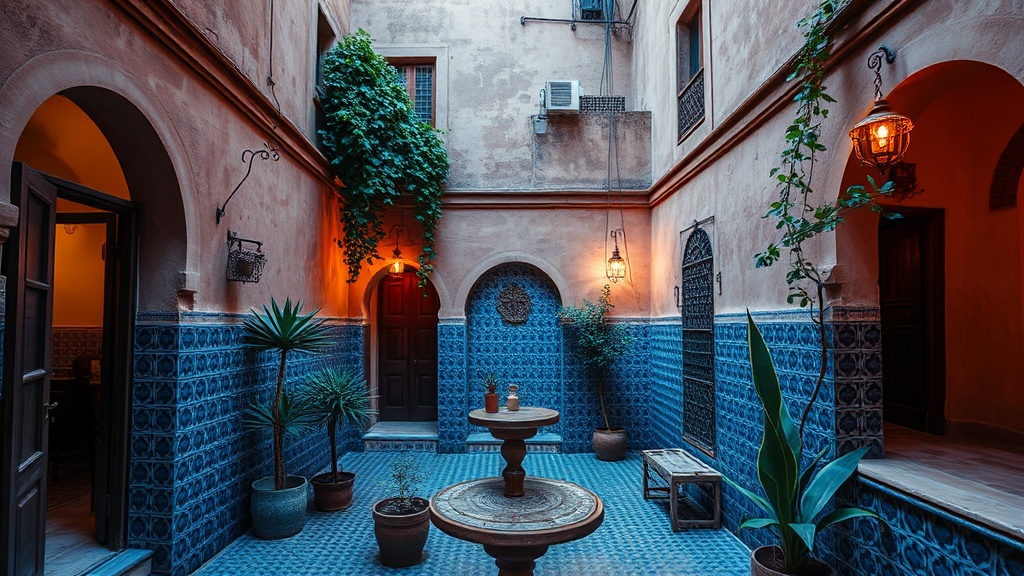
Beyond the Blue Tiles: A Curated Journey Through Marrakech's Riad Courtyards

The Emerald Oasis: Lush Gardens and Citrus Trees
The Marble Sanctuary: Minimalist Zen in the Medina
The Mosaic Marvel: Vibrant Zellige Tile Artistry
The Twilight Lounge: Candlelit Evening Retreats
This guide provides a technical and sensory blueprint for identifying, selecting, and experiencing the most authentic riad courtyards in Marrakech, focusing on architectural integrity, water features, and the subtle nuances of Moroccan hospitality.
To the uninitiated, the medina of Marrakech can feel like a relentless assault of sensory input—the scent of heavy cumin, the heat of the sun, and the constant motion of the souks. However, the true soul of the city is not found in the streets, but in the sudden, profound silence that occurs the moment you cross a threshold into a riad. A riad is more than a boutique hotel; it is a sophisticated piece of architectural engineering designed to create a private microclimate. By understanding the specific elements that define these spaces, you can move past the superficial "Instagrammable" aesthetics and find the dwellings that preserve the genuine heritage of Moroccan domestic life.
1. The Geometry of Silence: Identifying Authentic Zellige Patterns
The first indicator of a high-quality riad is the integrity of its zellige—the hand-cut geometric mosaic tilework. In many modern, mass-produced riads, you will see perfectly uniform, machine-made tiles. While visually clean, these lack the "soul" of traditional craftsmanship. Authentic zellige features slight irregularities in color and texture because each tile is hand-chipped from clay. When walking through a courtyard, look closely at the way light hits the surface; a true zellige pattern will have a subtle, organic shimmer rather than a flat, plastic sheen.
When selecting a riad based on its tilework, look for these specific hallmarks:
- Color Gradation: Genuine hand-glazed tiles often show slight variations in hue within a single color family, such as the deep cobalt or emerald green.
- Edge Precision: While the tiles are hand-cut, the geometric alignment should still respect complex mathematical symmetries, often based on star patterns or interlacing polygons.
- Material Weight: Authentic tiles are made from local clay and are significantly more durable and heavy than ceramic imitations.
2. The Hydro-Engineering of the Central Courtyard
The central courtyard, or patio, serves a dual purpose: it is a source of natural light and a cooling mechanism. The presence of water is not merely decorative; it is a functional necessity for temperature regulation. A well-designed riad will feature a central fountain or a long, narrow water basin designed to facilitate evaporative cooling. As the water evaporates, it lowers the temperature of the immediate air, creating a pocket of relief from the 40°C (104°F) heat of the Marrakech afternoon.
When evaluating a property, observe the sound and movement of the water. A small, recirculating pump that creates a gentle trickle is far more conducive to relaxation than a loud, splashing fountain. The sound of moving water acts as white noise, masking the distant chaos of the medina and reinforcing the sense of seclusion. This is a principle of architectural design similar to the way sound is managed in the hidden tea houses of Kyoto, where the environment is curated to direct the guest's attention inward.
The Role of Vegetation in Microclimate Control
A high-tier courtyard will also utilize specific botanical elements to enhance this cooling effect. Look for the presence of citrus trees—specifically bitter orange or lemon—and jasmine. These plants do more than provide a scent; the transpiration from their leaves adds moisture to the air, while the shade they cast prevents the stone floors from absorbing too much heat during the daylight hours.
3. Light and Shadow: The Mastery of Mashrabiya
In a truly exceptional riad, the lighting is never direct. Instead, it is filtered. This is achieved through the use of mashrabiya—intricate wooden lattice screens—and high, narrow windows. The goal is to create a play of light and shadow that changes throughout the day, a phenomenon known as "the dance of the sun."
As you move through the spaces, observe how the light interacts with the interior volumes:
- Morning: The light should be soft and diffused, filtered through the high courtyard walls.
- Midday: Look for the sharp, geometric shadows cast by the mashrabiya screens onto the floor. This prevents the glare from becoming overwhelming.
- Dusk: The transition to artificial light should be seamless, utilizing brass lanterns (fanous) that cast warm, patterned shadows across the plaster walls.
Avoid any riad that relies heavily on bright, overhead electric lighting. The architectural intent of the courtyard is to embrace the natural progression of the day. A space that is too brightly lit loses the depth and mystery that defines the Moroccan domestic experience.
4. The Sensory Nuance of the Tadelakt Finish
One of the most overlooked details in a luxury riad is the quality of the wall finish. Tadelakt is a traditional Moroccan plastering technique involving lime, water, and soap. It is applied by hand and then polished with a smooth stone to create a surface that is waterproof and incredibly soft to the touch. Unlike standard paint or even high-end modern plaster, Tadelakt has a luminous, tactile quality that feels organic.
How to test for quality Tadelakt:
- The Touch Test: Run your hand (if appropriate) or observe the light reflection. A real Tadelakt surface has a slight, waxy sheen and a subtle texture that feels "alive" rather than sterile.
- Color Depth: True Tadelakt achieves its color through the infusion of natural pigments. The color should look as though it is coming from within the material, rather than sitting on top of it.
- Durability: In areas near water features or in bathrooms, the Tadelakt should be flawless, showing no signs of cracking or water damage, as its waterproof nature is its primary functional benefit.
5. Curating the Evening: The Ritual of Mint Tea
The final element of a curated riad experience is the ritual of hospitality. In the most authentic establishments, the service is not a choreographed performance for tourists, but a practiced tradition. The preparation of Atay (Moroccan mint tea) is a critical moment of the day, usually occurring in the late afternoon or early evening when the courtyard's temperature begins to drop.
Pay attention to the details of the service. A high-quality experience will involve the use of heavy, silver-plated teapots and hand-blown glass. The tea itself should be prepared with fresh sprigs of Mentha (spearmint) and high-quality green tea leaves. The "height" from which the tea is poured—the long, graceful stream—is not just for show; it is a technical method used to aerate the tea and create a delicate layer of foam on the surface, which is the mark of a properly brewed cup.
"The true luxury of a riad is not found in the price of the linens, but in the depth of the silence found within its walls."
When you find a riad that respects these architectural and ritualistic standards, you are no longer a mere spectator of Marrakech. You become a participant in a centuries-old design philosophy that prioritizes privacy, cooling, and the quiet beauty of the everyday. Whether you are watching the shadow of a palm frond move across a Tadelakt wall or listening to the rhythmic drip of a central fountain, you are witnessing the enduring resilience of a culture that builds its sanctuary against the desert heat.